Table of Contents
Quick answer: Affiliate ROI is calculated as (revenue minus total costs) divided by total costs, multiplied by 100. The key mistake most affiliates make is only counting ad spend as cost. True ROI must include time valued at an hourly rate, tool subscriptions, content creation costs, and hosting fees.
Key takeaways
- True affiliate ROI includes time (valued at $30-50/hr for experienced marketers), tools ($50-200/mo for SEO and analytics), content costs, and hosting. Most affiliates undercount costs by 40-60%.
- SEO content has the highest long-term ROI (380-520% annualized on my accounts) but requires 3-6 months of negative ROI before breaking even.
- Paid display ads show positive ROI within 30 days but at lower margins (40-80% annualized). The tradeoff is speed vs. magnitude.
- LTV-adjusted ROI accounts for future revenue from referred spenders. A campaign with -20% 30-day ROI can have +180% 12-month ROI if spender retention is strong.
- Review ROI monthly but make budget decisions quarterly. Monthly fluctuations in cam site revenue are too noisy for reactive budget changes.
How to calculate ROI for affiliate campaigns
- 30-day ROI: Revenue earned within 30 days of the campaign cost being incurred, divided by the cost. This tells you short-term campaign efficiency. Useful for paid ads.
- LTV-adjusted ROI: Projected lifetime revenue from referred spenders, divided by the campaign cost. This accounts for the fact that cam site referrals generate commission for months or years after the initial signup. Better for SEO and content investments.
True cost accounting: time, tools, content, ads
| Cost category | Monthly amount | Notes |
|---|---|---|
| Time (content creation) | $480 | 12 hrs/mo x $40/hr |
| Time (SEO/link building) | $320 | 8 hrs/mo x $40/hr |
| Time (social media) | $240 | 6 hrs/mo x $40/hr |
| Time (analytics/reporting) | $160 | 4 hrs/mo x $40/hr |
| SEO tools (Ahrefs) | $99 | Lite plan |
| Hosting (Vercel + domain) | $25 | Pro plan |
| Paid ads (display) | $400 | Variable, some months $0 |
| Content (freelance writers) | $300 | 2-3 articles/mo |
| Total | $2,024 | Varies by month |
If you are not tracking time spent per traffic source, start now. Use a simple timer app or just log hours in a spreadsheet. Without time data, your ROI calculations are fiction.
ROI by traffic source comparison
| Traffic source | Monthly cost | Monthly revenue | 30-day ROI | LTV-adjusted ROI (annual) | Payback period |
|---|---|---|---|---|---|
| SEO (review content) | $620 | $1,840 | +197% | +480% | 4.2 months |
| SEO (informational) | $440 | $680 | +55% | +310% | 5.8 months |
| Reddit/forums | $280 | $310 | +11% | +120% | 3.1 months |
| Twitter/X | $160 | $190 | +19% | +140% | 2.8 months |
| Paid display ads | $540 | $620 | +15% | +65% | 28 days |
When negative ROI is actually acceptable
- Month 1: Cost $350 (writing + time). Revenue $0-40. ROI: -88% to -100%.
- Month 2: Cost $60 (maintenance time). Revenue $60-120. Cumulative ROI: -51% to -75%.
- Month 3: Cost $40 (minimal updates). Revenue $100-180. Cumulative ROI: -13% to -40%.
- Month 4-6: Cost $30/mo. Revenue $120-220/mo. Cumulative ROI crosses positive.
- Month 7-12: Cost $20/mo. Revenue $140-260/mo from existing + new spenders. ROI accelerates.
Set a maximum payback period you are comfortable with. Mine is 6 months. If a campaign or content piece is not projected to reach positive cumulative ROI within 6 months based on similar cohort performance, I do not invest in it.
Monthly ROI tracking framework
- Direct costs: Ad spend, freelancer payments, tool costs allocated to this source.
- Time costs: Hours spent x hourly rate.
- 30-day revenue: Commission earned this month from spenders attributed to this traffic source (using tracker tags).
- Cumulative revenue: All commission ever earned from spenders attributed to this source.
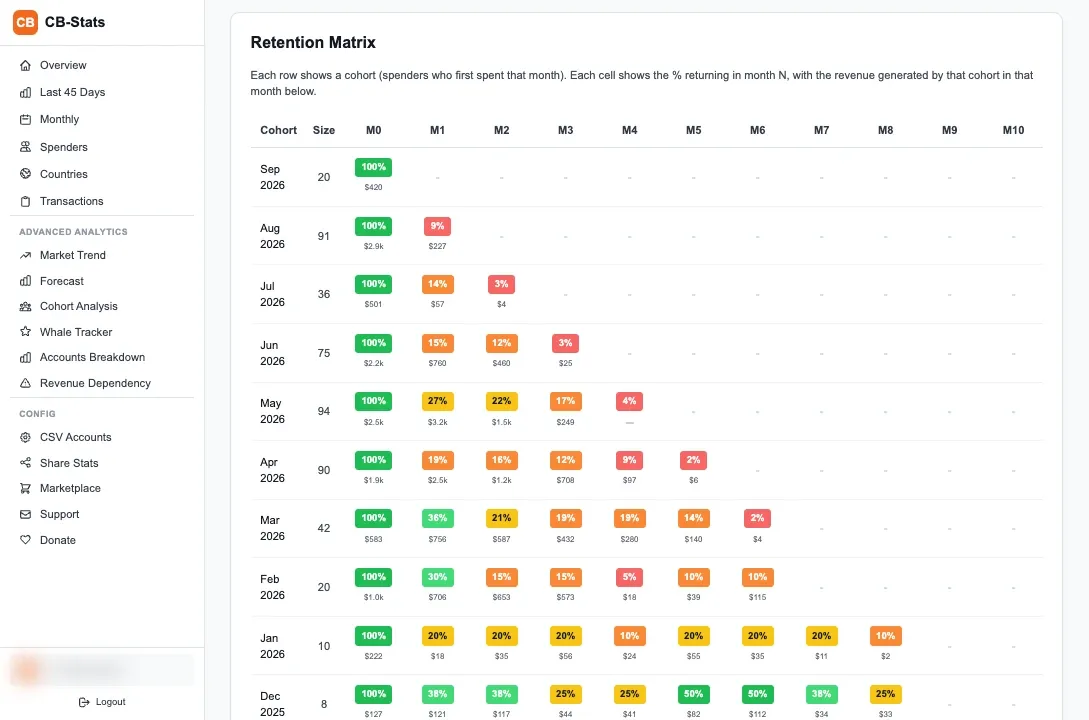
- LTV projection: Current cumulative revenue + projected future revenue based on cohort retention curves for this source.
ROI-based budget allocation strategy
| Traffic source | LTV-adjusted ROI | Budget allocation | Monthly budget |
|---|---|---|---|
| SEO (review content) | 480% | 35% | $710 |
| SEO (informational) | 310% | 22% | $445 |
| Reddit/forums | 120% | 12% | $245 |
| Twitter/X | 140% | 11% | $225 |
| Paid display ads | 65% | 5% | $100 |
| Testing new channels | Unknown | 15% | $300 |
Frequently Asked Questions
How do I calculate affiliate ROI if I do not pay for ads?
Even without ad spend, you have costs: your time (valued at a reasonable hourly rate), hosting, domain, SEO tools, and content creation. Track hours spent per traffic source and multiply by your hourly rate. A "free" traffic source that takes 20 hours/month at $40/hour costs $800/month. Calculate ROI using these true costs.
What is a good ROI for cam site affiliate campaigns?
A 30-day ROI above 50% is good for paid campaigns. For organic campaigns (SEO, social), LTV-adjusted annualized ROI of 200%+ is strong. Below 50% annualized for any established channel should prompt a review of whether that channel is worth your time. New channels get a 6-month grace period before ROI expectations apply.
Should I use 30-day ROI or LTV-adjusted ROI for decisions?
Use LTV-adjusted ROI for budget allocation and strategic decisions because it accounts for the full value of referred spenders over their lifetime. Use 30-day ROI for evaluating paid ad campaigns where you need fast feedback and cash flow management. Both numbers serve different purposes.
How much should I value my time at for ROI calculations?
Use a rate between what you could earn in alternative work and what you would pay someone to replace your effort. For most experienced affiliate marketers, $30-50/hour is reasonable. The exact number matters less than being consistent. If you use $40/hour, use it for every calculation so comparisons between channels are fair.
How often should I recalculate ROI for each traffic source?
Calculate monthly but make decisions quarterly. Monthly data is too volatile for cam site affiliates because whale activity, seasonal trends, and traffic fluctuations create noise. Quarterly averages give a clearer signal. Review your monthly numbers for trends but wait for 3 months of data before making budget changes.