Return on investment (ROI) measures how much profit an affiliate campaign generates relative to its cost, expressed as a percentage.
Quick answer: ROI is calculated as (revenue - cost) / cost x 100. If you spend $100 on ads and earn $300 in commission, your ROI is 200%. For organic traffic, your cost is your time.
Key takeaways
ROI formula: (commission earned - total cost) / total cost x 100
Positive ROI means profit. 100% ROI means you doubled your money
For organic affiliates, factor in the time cost of content creation, not just cash expenses
Recurring commission means your ROI improves over time as referrals keep spending
What ROI means for cam affiliates
ROI tells you whether a campaign makes money or loses it, expressed as a percentage of your investment. Spend $500 on tube site ads, earn $1,200 in commission, your ROI is 140%. That means for every dollar you invested, you got $1.40 back in profit on top of your original dollar. Anything above 0% is profitable. Anything below means you lost money.
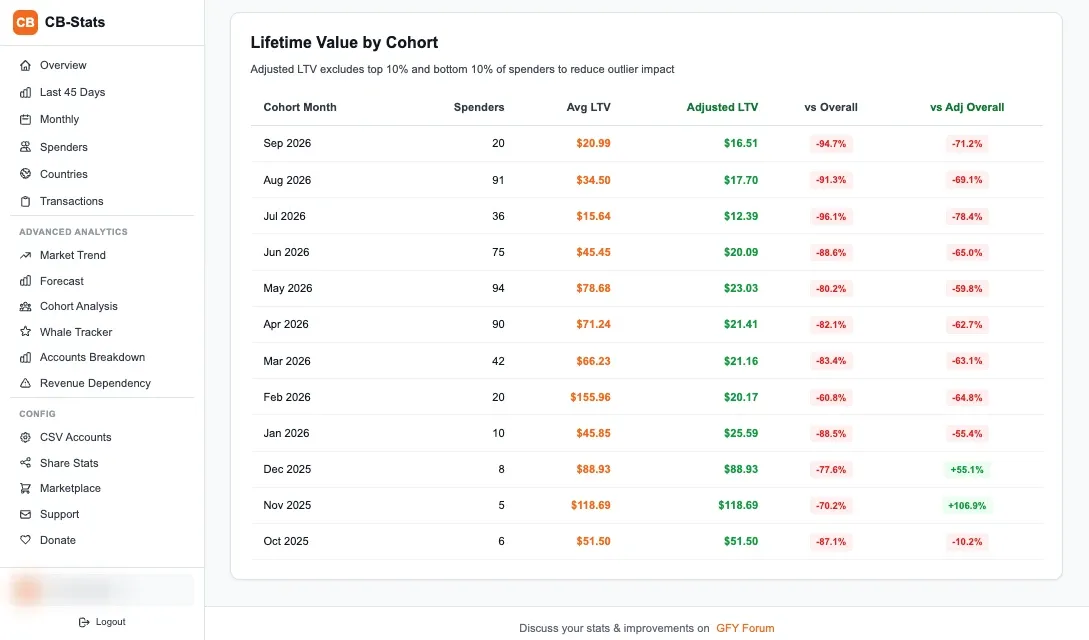
The tricky part with cam affiliate ROI is the time dimension. A campaign might show -20% ROI in the first month because revshare earnings are low. By month 3, those same referrals have made repeat purchases and the campaign sits at +150% ROI. You need to track ROI over the lifetime of the referrals, not just the first 30 days.
Calculating ROI for paid vs organic traffic
Paid traffic ROI is straightforward math because you have a clear dollar cost, while organic traffic ROI requires you to assign a value to your time. If you bought $200 in banner ads and earned $600 in commission, ROI is 200%. Simple. But if you spent 20 hours writing blog posts that generated $600, you need to decide what your time is worth to calculate real ROI.
Traffic type
Cost
Revenue
ROI
Tube site banners
$500/month
$1,100/month
120%
SEO blog content
40 hours ($0 cash)
$800/month (recurring)
Infinite cash ROI, time ROI varies
Reddit posts
5 hours/week ($0 cash)
$400/month
No cash cost, time investment only
Pop-under ads
$300/month
$250/month
-17% (unprofitable)
Organic traffic has no cash cost, which technically makes the cash ROI infinite. But your time has value. If those 40 hours of writing could earn you $2,000 freelancing, then $800/month in affiliate commission needs about 3 months to break even on the opportunity cost. After that, the content keeps earning while requiring minimal maintenance.
Why revshare changes your ROI calculation
Recurring revshare commission means your ROI keeps improving after the campaign ends, because referrals continue spending without any additional cost to you. A paid campaign that shows 50% ROI in month 1 might show 300% ROI by month 6 when you include all the repeat purchases from the same referrals. This is why short-term ROI measurements in cam affiliate marketing are misleading.
I track ROI at 30, 90, and 180-day windows for every campaign. The 30-day number tells me if a campaign is worth continuing. The 90-day number tells me the real performance. The 180-day number tells me the long-term value of that traffic source. Some campaigns that looked unprofitable at day 30 became my best performers by day 90.
For paid traffic, aim for 100%+ ROI (doubling your money) after 90 days. Anything above 50% at 30 days usually grows to 150%+ over time with recurring commission. For organic traffic, any positive ROI is good since your cash cost is zero and the content continues earning.
How do I improve my affiliate ROI?
Focus on traffic quality over quantity. Cut campaigns with negative 90-day ROI. Double down on traffic sources that produce repeat spenders, not just signups. Use CB-Stats to identify which trackers generate the highest lifetime value per referral, then invest more in those sources.
Should I calculate ROI on first-month commission or lifetime commission?
Both. First-month ROI tells you if a campaign is viable enough to keep running. Lifetime ROI (or at least 90-day ROI) tells you the true value of that traffic. Make scaling decisions based on 90-day ROI, not 30-day. Many profitable campaigns look negative in the first month.
C
About the author
Clement
Founder of CB-Stats, Chaturbate & Stripchat Super affiliate