Theory18Webmasters

Affiliate programs, traffic
& earnings.

Cam site whale spenders: how top 5% of users drive 60% of affiliate revenue

A data-backed look at whale spenders on cam sites, how they behave, why they matter disproportionately to affiliate revenue, and what happens when they churn. Based on 7 years of tracking high-value referrals.

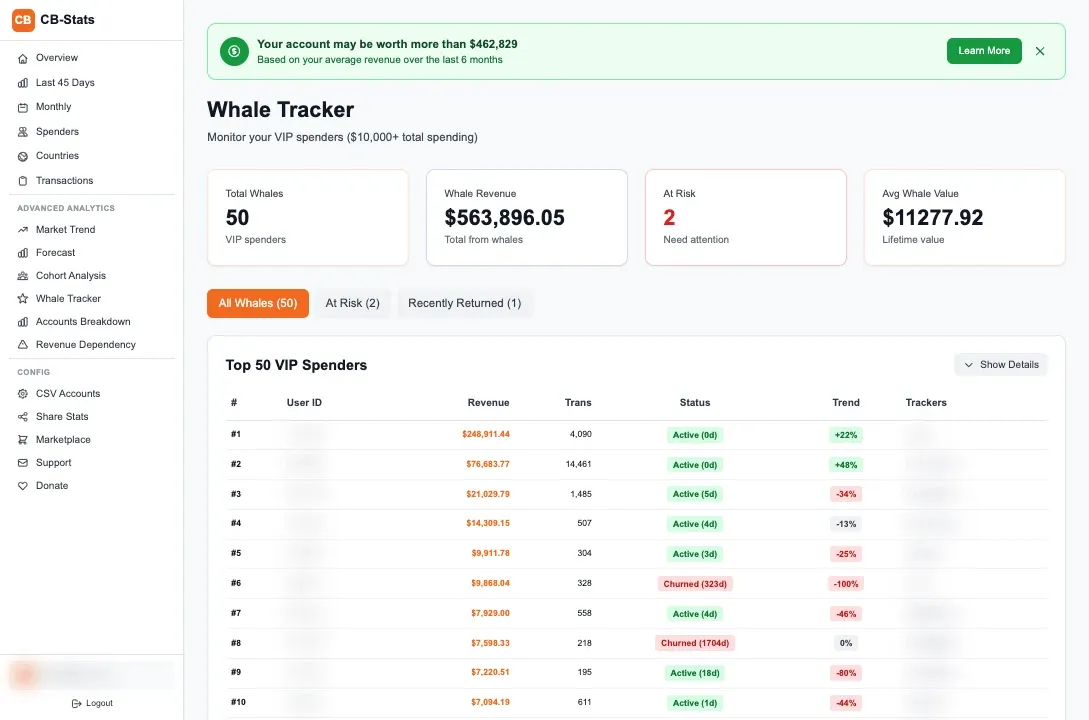
CB Stats whale activity overview with spender identities obscured.
Table of Contents

Quick answer: A whale spender on cam sites is a user who spends $10,000 or more in tokens over their account lifetime, generating $2,000+ in affiliate commission. These users typically represent 3-5% of your referred spender base but contribute 55-65% of total revenue.

Key takeaways

  • Whale spenders ($10,000+ lifetime spend) make up roughly 4% of referred spenders but generate 58-63% of total affiliate commission on my accounts.
  • The average whale makes token purchases across 14 months before going inactive, compared to 3 months for regular spenders.
  • SEO traffic produces whales at 2.3x the rate of social media traffic based on my tracker data.
  • A whale going inactive for 30+ days after consistent spending is the first warning sign of churn. Recovery rate drops to 15% after 60 days.
  • Building revenue around whales works but requires monitoring. Losing 2-3 whales in a quarter can drop monthly revenue by 25-30%.
Every affiliate who runs cam site accounts long enough discovers the same thing: a small group of referred users generates most of the money. I have tracked this pattern across 8 million+ transactions on my accounts and the distribution is consistent year after year. Understanding whale spenders is not optional if you want to make informed decisions about your affiliate business.
This article is part of the cam site affiliate revenue guide. Related reading: spender retention strategies and seasonal revenue trends that affect whale behavior.

What qualifies as a whale spender on cam sites

A whale spender is a referred user who has spent $10,000 or more in tokens over their account lifetime, which translates to $2,000+ in affiliate commission at the standard 20% revshare rate. The $10,000 threshold is not arbitrary. It is roughly the point where a single user's commission contribution starts to meaningfully affect your monthly revenue.
On Chaturbate, $10,000 in token spending means the user has purchased approximately 90,000-100,000 tokens across their lifetime (the exact number varies by purchase bundle size). For context, a 500-token purchase costs $44.99. A user reaching whale status has made at least 180-200 separate token purchases at the 500-token level, or fewer at higher denominations.
I use a tiered classification in CB-Stats to segment spenders beyond the basic whale threshold.
TierLifetime token spendAffiliate commission% of my referred spenders
Casual spenderUnder $500Under $10068%
Regular spender$500 - $2,500$100 - $50021%
Heavy spender$2,500 - $10,000$500 - $2,0007%
Whale$10,000 - $50,000$2,000 - $10,0003.4%
Super whale$50,000+$10,000+0.6%
That bottom 68% of casual spenders generates about 11% of total revenue. The top 4% (whales + super whales) generates 61%. The math is lopsided and it stays lopsided no matter how much traffic you add.

How whale spenders impact affiliate revenue

On my accounts, the top 5% of referred spenders generate 63% of total lifetime commission revenue, and this ratio has held within 3 percentage points every year since 2019. This power-law distribution is the defining characteristic of cam site affiliate economics. It means your revenue is concentrated in a small number of users.
Here is why this matters in practice. My primary Chaturbate account has approximately 1,580 referred users who have made at least one token purchase. Of those, 54 qualify as whales ($10,000+ lifetime spend). Those 54 users have generated roughly $187,000 in total commission. The remaining 1,526 spenders combined have generated about $115,000. Fifty-four people produce more revenue than fifteen hundred.

DataRevenue concentration on one account

Top 1 spender: $14,200+ in commission (lifetime). Top 5 spenders: $42,000+ combined. Top 54 spenders (whales): $187,000 combined. Remaining 1,526 spenders: $115,000 combined. This is why losing a single whale hurts more than losing 50 casual spenders.

The flip side of this concentration is volatility. When a whale goes inactive, you feel it immediately in your monthly numbers. I had a super whale who was spending $800-$1,200/month in commission suddenly stop in March 2024. My monthly revenue dropped 18% overnight. It took 3 months for new spender growth to fill the gap.
This concentration also explains why two affiliates with similar traffic volumes can have wildly different revenue. If one has 3 whales and the other has zero, the first affiliate might earn 4x more from fewer total signups. It is not about volume. It is about who you attract.

Identifying whale patterns with analytics

Whales do not become whales overnight. They follow a predictable escalation pattern: moderate first purchase, increasing purchase frequency over 2-3 months, then stabilizing at a high spending level for 6-18 months. Spotting this pattern early lets you understand which traffic sources produce whale-potential users.
The CB-Stats whale tracker flags users who have crossed the $10,000 threshold and categorizes them by activity status: active (purchased within 30 days), at-risk (30-59 days since last purchase), danger (60-89 days), and churned (90+ days). This status system is based on the spending patterns I observed across thousands of users over years of tracking.

Early indicators of whale behavior

Before a user hits whale status, there are signals in their spending history. The most reliable one: purchasing tokens more than 8 times in their first 60 days. On my accounts, users who made 8+ purchases in their first 2 months had a 23% chance of eventually becoming whales. Users who made 2-3 purchases had a 1.4% chance.
  • High initial purchase frequency (8+ transactions in the first 60 days)
  • Buying larger token bundles (500+ tokens per purchase) after the first 2-3 purchases
  • Consistent daily or near-daily purchasing patterns
  • Spending that increases month over month rather than declining
  • Purchasing across multiple time zones, which indicates habitual use
You cannot influence whether a referred user becomes a whale. That depends on their income, personality, and relationship with specific cam models. But you can track which of your traffic sources produce users with whale-like early behavior, and then allocate more budget to those sources.

Traffic sources that attract whale spenders

SEO traffic from review and comparison content produces whale spenders at 2.3x the rate of social media traffic and 3.8x the rate of forum traffic on my accounts. The likely explanation: users who search for cam site reviews and token value comparisons have already decided to spend money. They are further down the buying funnel.
Traffic sourceSpenders per 1,000 signupsWhale rate per 1,000 spendersAvg whale LTV
SEO (review content)14241$18,400
SEO (informational)9828$14,200
Reddit/forums4311$12,800
Social media (Twitter/X)3818$15,600
Paid ads (display)6714$11,300
Social media is interesting. It produces fewer spenders overall but the ones who do spend have a decent whale conversion rate. My theory: social media users who click through to a cam site despite the public nature of the platform are already committed. They are not casual browsers.
Forum traffic (Reddit, GFY, adult webmaster forums) produces lots of signups but very few whales. Forum users tend to be price-conscious, comparison-shopping types who churn faster. The exceptions are niche community referrals where users have a specific interest that maps to specific cam models.
I track all of this with separate tracker tags on every traffic source and check performance monthly. The commission structure article covers how to set up tracker-level analysis if you have not done this yet.

When whales churn: warning signs and recovery strategies

The first warning sign of whale churn is a gap of 30+ days between purchases after a period of consistent weekly or bi-weekly spending. On my accounts, whales who go 30 days without a purchase have a 62% chance of returning. At 60 days, that drops to 15%. At 90 days, it is under 5%.
You cannot contact referred users directly. You have no email address, no username (just an anonymized ID), and no way to re-engage them. This is a limitation of the affiliate model. All you can do is monitor the patterns and adjust your overall strategy.

Common whale churn triggers

  • A favorite cam model retires or moves platforms. This is the most common trigger and there is nothing you can do about it.
  • Financial changes in the whale's personal life (job loss, relationship changes).
  • Platform fatigue after 12-18 months of heavy use. Many whales take breaks and some return.
  • Seasonal patterns. Whales are less active in summer just like regular spenders, but the revenue impact is bigger. See seasonal trends.
  • Payment method issues. Credit card changes, bank blocks on adult transactions.
When a whale churns, the revenue impact is immediate and significant. My approach is to track whale status weekly in CB-Stats and mentally model my revenue with and without each top whale. If I have 8 active whales contributing $2,400/month combined and 2 of them show at-risk status, I know my revenue could drop by $600/month in the next quarter.

Do not count on churned whales returning. While some do (roughly 8% of 90-day churned whales come back eventually), the revenue gap they leave needs to be filled by new spender acquisition and growth of existing heavy spenders into whale territory.

Building a whale-dependent revenue strategy

Every cam site affiliate business is whale-dependent whether you plan for it or not, because the revenue distribution guarantees that a small number of users will always dominate your earnings. The question is not whether to depend on whales. It is whether you monitor that dependency and manage the risk.
Here is the framework I use after years of learning this the hard way.

Diversify whale sources

If all your whales come from one traffic source and that source dries up, you are finished. I spread my efforts across 4-5 active traffic channels. No single channel produces more than 35% of my whales. This means if Google changes an algorithm and my SEO traffic drops 50%, I lose some whales but not all of them.

Maintain a healthy whale pipeline

I track "heavy spenders" ($2,500-$10,000 lifetime) as my whale pipeline. These are users who are spending enough to potentially cross the whale threshold in the next 6-12 months. Right now I have about 110 heavy spenders across my accounts. Some will stall, some will churn, and some will cross $10,000. If the pipeline stays healthy, whale count stays stable even as individual whales churn.

Do not over-optimize for whales

There is a temptation to focus exclusively on traffic sources that produce whales and ignore everything else. This is a mistake. Regular spenders provide baseline revenue that is more stable and predictable. A healthy account has strong whale revenue and a broad base of regular spenders. Target a ratio where whales generate no more than 65% of total revenue. If whale concentration goes above 70%, your account is fragile.
Improving retention across all spender tiers is the best way to build this base. A regular spender who retains for 18 months is worth more than a whale who churns after 4 months.

Frequently Asked Questions

What counts as a whale spender on Chaturbate?

A whale spender is a user who has spent $10,000 or more in tokens over their account lifetime, generating $2,000+ in affiliate commission at the 20% revshare rate. On most affiliate accounts, whale spenders make up 3-5% of total referred spenders but contribute 55-65% of total revenue.

How many whale spenders does a typical affiliate account have?

It depends on traffic volume and quality. An account with 1,000-2,000 referred spenders typically has 30-80 whales. SEO-driven accounts tend to have higher whale concentrations (4-5% of spenders) compared to social media driven accounts (2-3%). New accounts under 12 months old may have zero whales since it takes time for users to accumulate $10,000 in spending.

Can you prevent whale spenders from churning?

No. As an affiliate, you have no direct contact with referred users and no way to re-engage them. Whale churn is driven by factors outside your control: favorite models leaving the platform, personal financial changes, or platform fatigue. What you can do is monitor whale activity patterns, maintain a pipeline of heavy spenders growing toward whale status, and diversify traffic sources so whale churn from one channel does not collapse your revenue.

Which traffic sources produce the most whale spenders?

SEO traffic from review and comparison content produces whales at approximately 2-3x the rate of social media or forum traffic. Users who find cam sites through detailed review content tend to have higher spending intent and longer retention. However, every traffic source can produce whales, so diversification is more important than betting everything on one channel.

How do I track whale spenders on my affiliate account?

Chaturbate's native affiliate dashboard does not flag whale spenders specifically. You need an analytics tool like CB-Stats that processes your CSV export data and identifies users above the $10,000 spending threshold. CB-Stats categorizes whales by activity status (active, at-risk, danger, churned) based on days since their last purchase.
Theory18 community

Join the conversation

Loading comments…