
Theory18Webmasters

Affiliate programs, traffic
& earnings.

How to scale your cam site affiliate business past $5,000/month

Scaling a cam affiliate business requires a different approach at each revenue tier. Here is the exact playbook I used to go from $500/month to $10,000+/month over 26 months, with specific tactics for each stage.

A modular equipment rack stands beside orange and blue expansion blocks.
Table of Contents

Quick answer: Scaling a cam site affiliate business past $5,000/month requires content multiplication (publishing 15-25 articles/month), hiring writers who can handle adult content, selectively introducing paid traffic on proven converters, and building 2-3 niche sites instead of one general site. Most affiliates hit the $5K milestone within 18-24 months of consistent work.

Key takeaways

  • The $500/month milestone is achievable with 30-40 published articles and 10,000+ monthly organic visitors on a single site.
  • Hiring 1-2 writers at $0.05-0.08/word for adult content doubles your publishing output for $800-1,200/month.
  • Paid traffic becomes profitable only after you know your revenue per click from organic data. Never run ads before that.
  • Building a second niche site at $2,000/month revenue is more effective than scaling one site past its keyword ceiling.
  • The jump from $5,000 to $10,000/month usually requires either multiple sites, paid traffic, or both.
I spent 8 months stuck at $1,800/month. Published more content, optimized existing pages, added internal links. Nothing moved the number. The problem was not effort. It was that I was doing the same things that got me to $1,800 and expecting them to get me to $5,000. Scaling requires changing your approach at each revenue tier.
This guide breaks down the specific changes I made at each stage. It connects to the cam site affiliate revenue guide for the foundational strategy and the multi-platform strategy guide for expanding across programs.

When to start scaling your cam affiliate business

Start scaling when you have at least 30 published articles generating $500+/month in consistent affiliate revenue for 3 consecutive months. Scaling before you have a proven content-to-revenue pipeline is like pouring water into a bucket with holes. You need to know which content types convert, which traffic sources produce spenders, and what your revenue per 1,000 visitors looks like.
The 3-month consistency rule matters. I have seen affiliates hit $800 in one month from a single viral Reddit post, then drop back to $200 the next month. That is not a foundation to scale on. You need revenue that comes from organic search, repeats monthly, and grows slightly each month. That pattern means your SEO content is working.
  • 30+ published articles that target specific keywords with clear search intent
  • $500+/month for 3 consecutive months from organic traffic (not one-time social spikes)
  • A clear best-performing content type (reviews, comparisons, or guides) that you can replicate
  • Tracker data showing which pages generate revenue and which are dead weight
  • Revenue per 1,000 visitors above $50 (below that, your conversion funnel needs fixing before you scale)

WarningScaling too early

I launched my second site at $400/month revenue. It split my attention, slowed content production on both sites, and neither reached $1,000/month for 9 months. If I had focused on the first site until $2,000/month, I would have hit $5,000 total about 6 months sooner. Patience at the early stage compounds into speed later.

Content multiplication strategies

Content multiplication means turning 1 research session into 3-5 published articles by branching a single topic into multiple search intents, formats, and angles. At the $500-2,000/month stage, you cannot afford to research every article from scratch. Multiplying content from existing research is how you go from 8 articles/month to 20 without burning out.
Here is a real example from my workflow. I research Chaturbate's token pricing for a review update. From that single research session I produce: (1) a review update with current pricing, (2) a "how to buy Chaturbate tokens" guide, (3) a "Chaturbate tokens cost" comparison table post, (4) a FAQ-style article on "are Chaturbate tokens worth it," and (5) an update to my Chaturbate vs Stripchat comparison with fresh pricing data. Five pieces of content from one research session.

The hub and spoke method

Every pillar topic becomes a hub page with 4-6 spoke articles. The hub ranks for the head keyword. The spokes rank for long-tail variations and link back to the hub. My "best cam sites" hub page links to individual reviews, comparison articles, and niche-specific listicles. Google treats the cluster as a topical authority signal and the whole group ranks higher than standalone articles would.

Updating over rewriting

An article update takes 45 minutes. A new article takes 3-4 hours. Updating existing content that already ranks (positions 5-20) often produces faster revenue gains than publishing something new. I spend 30% of my content time on updates. Changing the date, adding a new section, refreshing screenshots, and re-submitting to Google Search Console can push a page from position 12 to position 4 within 3 weeks.

TipContent velocity targets by revenue tier

$500/month: 8-10 articles/month (solo). $2,000/month: 15-20 articles/month (solo + 1 writer). $5,000/month: 20-30 articles/month (solo + 2 writers or 1 full-time). Above $5K, quality control matters more than raw volume.

Hiring writers for adult affiliate content

Finding writers who can produce quality adult affiliate content is harder than mainstream niches but not impossible. Expect to pay $0.05-0.08/word and test 5-8 writers before finding 1-2 reliable ones. The main challenges are that many freelancers refuse adult work, quality varies wildly, and writers rarely understand affiliate conversion without training.
I hired my first writer at the $1,200/month revenue mark. She produced 8 articles per month at $0.06/word, costing about $720/month for 1,500-word articles. Within 3 months, those 24 articles were generating $900/month in revenue. By month 6, they produced $1,800/month. The ROI was clear but it took patience.

Where to find adult content writers

  • Adult webmaster forums (GFY, XBIZ) have writers who already understand the niche. Higher quality, higher rates ($0.08-0.12/word).
  • General freelance platforms (Fiverr, Upwork) work if you filter for writers open to adult content. Post clear job descriptions that specify the niche upfront.
  • Content mills are cheap ($0.02-0.04/word) but quality is terrible for adult affiliate content. I wasted $400 on mill content that needed full rewrites.
  • Reddit communities like r/HireaWriter occasionally have writers experienced in adult niches. DM responders with a paid test assignment.

Training writers for affiliate conversions

Good writing is not the same as good affiliate writing. I give every new writer a 2-page brief that covers: where to place affiliate link mentions (after a benefit statement, never cold), how to write comparison verdicts that lead to clicks, and the exact tone I want (conversational, specific numbers, no hype). The brief takes 30 minutes to create and saves hours of revision.
I pay a $50 bonus for every article that generates $100+ in tracked affiliate revenue within 6 months. This aligns the writer's incentive with my business goals. 2 of my writers now actively suggest article ideas based on keyword research they do on their own because they know high-performing content earns them more.
Paid traffic for cam affiliates becomes profitable only after you know your organic revenue per click (RPC) and can target that same audience through ads at a cost per click below your RPC. Running paid traffic before you have organic conversion data is gambling. Running it after you have data is math.
My organic RPC for Chaturbate is $0.38 across all traffic. For comparison page traffic specifically, it is $0.67. For review page traffic, $0.31. These numbers tell me I can pay up to $0.60 per click on ads pointing to comparison pages and still profit. If a paid traffic source costs more than my RPC, I skip it.
Traffic sourceAvg CPCConversion qualityBest for
ExoClick (adult native ads)$0.05-0.15MediumComparison landing pages, listicles
TrafficJunky (Pornhub network)$0.08-0.25HighDirect cam site promotions
Push notifications (adult networks)$0.01-0.05LowVolume testing, retargeting
Reddit ads (select subreddits)$0.30-0.80HighNiche-targeted review content
SEO (for comparison)$0.00HighestBaseline, all content types
I started paid traffic at the $3,000/month organic revenue mark with a $500/month test budget on ExoClick. First month ROI was -20% (lost $100). Second month broke even after I cut underperforming ad creatives. Third month generated $680 in commission on $500 spend. By month 6, paid traffic added $1,200/month in profit on $800/month spend.

InfoThe 10% rule for paid traffic budgets

Never spend more than 10% of your total monthly revenue on paid traffic tests until you have 3 consecutive profitable months. At $3,000/month revenue, that means a $300/month test budget. This limits downside while you learn which ad platforms, creatives, and landing pages convert for your specific audience.

Building multiple niche sites

Launching a second niche site becomes the right move when your first site hits its keyword ceiling, which for most cam affiliate niches happens around $2,000-3,000/month in organic revenue. A keyword ceiling means you have already published content for 80%+ of viable keywords in your niche and new articles target increasingly low-volume terms.
My first site was a general cam review site. It peaked at $2,800/month after 14 months because I had covered every major platform, comparison, and how-to topic. New articles targeted keywords with under 100 monthly searches. The effort-to-revenue ratio tanked. My second site targeted a specific niche (couples cams) and hit $1,200/month in just 7 months because the competition was lower.

Choosing your second niche

  • Pick a sub-niche of your main market: couples cams, VR cams, MILF cams, free cam sites. These have lower competition and focused buyer intent.
  • Check keyword volume before committing. A niche needs at least 50 viable keywords with 100+ monthly search volume each to support a standalone site.
  • Avoid niches that overlap too heavily with your first site. If 40%+ of the keywords are the same, you are competing with yourself.
  • Consider geographic niches for sites in non-English languages. German and Spanish cam affiliate content has 80% less competition than English.

Running multiple sites efficiently

I run 3 cam affiliate sites. The key to not drowning in work is templating everything. Same WordPress theme, same plugin stack, same content brief format, same tracker naming convention. A new site takes 2 hours to set up because I clone the configuration from an existing one. Writers use the same brief template for all sites, just swapped for the niche focus.
Content allocation across sites follows revenue potential. My general site gets 40% of new content. The couples niche site gets 35%. The VR cam site gets 25%. I re-evaluate the split every quarter based on which site has the most untapped keyword opportunities and the best revenue per article ratio.

Revenue milestones: $500, $2,000, $5,000, $10,000/month

Each revenue milestone in cam affiliate marketing requires a different strategy, different time investment, and different skills than the one before it. What gets you to $500 (solo content grind) will not get you to $5,000 (team, multiple sites, possibly paid traffic). Here is what each stage looks like from my experience and from talking with other affiliates earning at these levels.

$500/month: the proof of concept

Timeline: 4-8 months. Requirements: 30-40 published articles, 10,000+ monthly organic visitors, 1 cam platform. At this stage, you are doing everything yourself. Writing, SEO, link building, site maintenance. The goal is proving that your niche and content approach can generate recurring revenue. I hit $500/month at month 6 with 34 published articles on a Chaturbate review site.

$2,000/month: the optimization phase

Timeline: 10-16 months total. Requirements: 60-80 articles, 25,000+ monthly visitors, 1-2 platforms. The jump from $500 to $2,000 comes from three things. First, your early articles start compounding as Google trusts your domain more. Second, you add a second affiliate platform (Stripchat) which captures visitors who bounce from your primary. Third, you start optimizing existing content instead of only publishing new pieces. I hired my first writer at this stage.

$5,000/month: the systems phase

Timeline: 18-24 months total. Requirements: 100-150 articles across 1-2 sites, 50,000+ monthly visitors, 2-3 platforms, 1-2 writers. At $5,000/month you are running a small business, not a side project. Content production is partially outsourced. You have a second site or are planning one. Analytics and tracking are sophisticated enough that you know your RPC by page, traffic source, and platform. This is where most successful cam affiliates plateau unless they make deliberate changes.

$10,000/month: the business phase

Timeline: 24-36 months total. Requirements: 200+ articles across 2-3 sites, 100,000+ monthly visitors, 2-3 platforms, 2-3 writers, possibly paid traffic. The $10K mark usually requires either massive organic traffic (100K+/month), profitable paid campaigns, or a network of 3+ niche sites all performing at the $3-4K level. I crossed $10K at month 26 with 2 sites, 1 writer, and a $1,200/month ExoClick budget.
MilestoneTimelineArticles neededTraffic neededKey action
$500/mo4-8 months30-4010,000+/moProve the model works with consistent organic revenue
$2,000/mo10-16 months60-8025,000+/moAdd 2nd platform, hire first writer, optimize existing content
$5,000/mo18-24 months100-15050,000+/moBuild systems: writers, 2nd site, sophisticated tracking
$10,000/mo24-36 months200+100,000+/moMultiple sites, paid traffic, team management

DataThe compounding effect

Cam affiliate revenue compounds because of lifetime revshare. A user I referred in month 3 is still generating commission in month 26. My month-3 cohort of referred users has produced $14,200 in total commission so far. Every month, old referrals keep earning while new content brings fresh ones. By month 18, 40% of my monthly revenue came from users referred more than 6 months earlier.

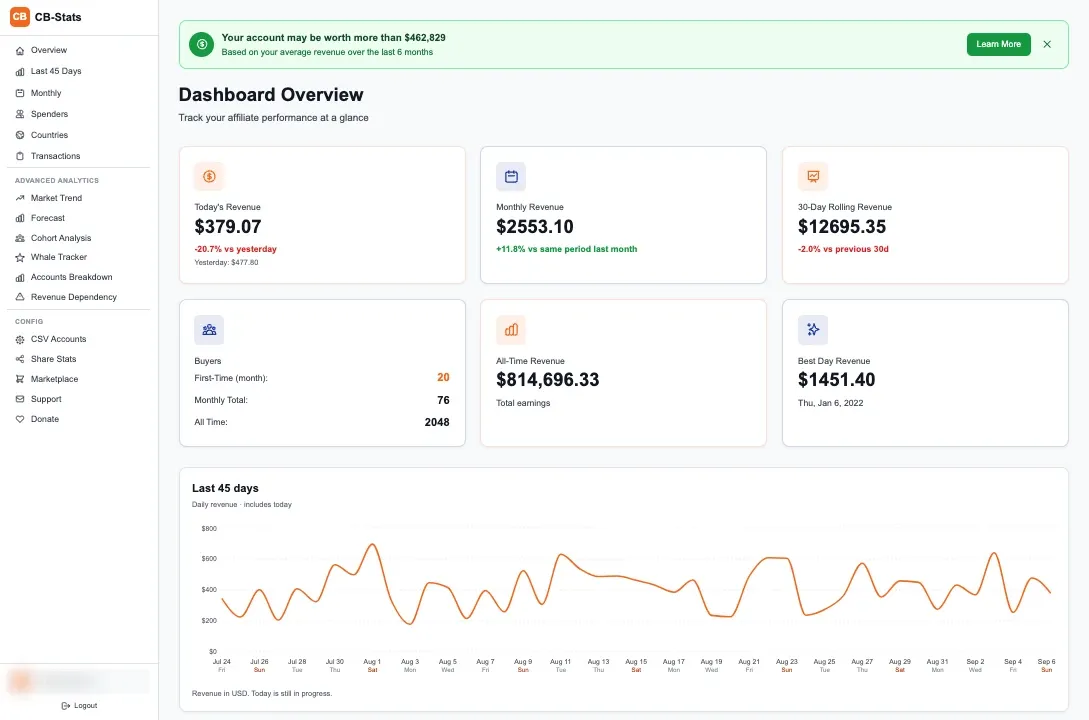
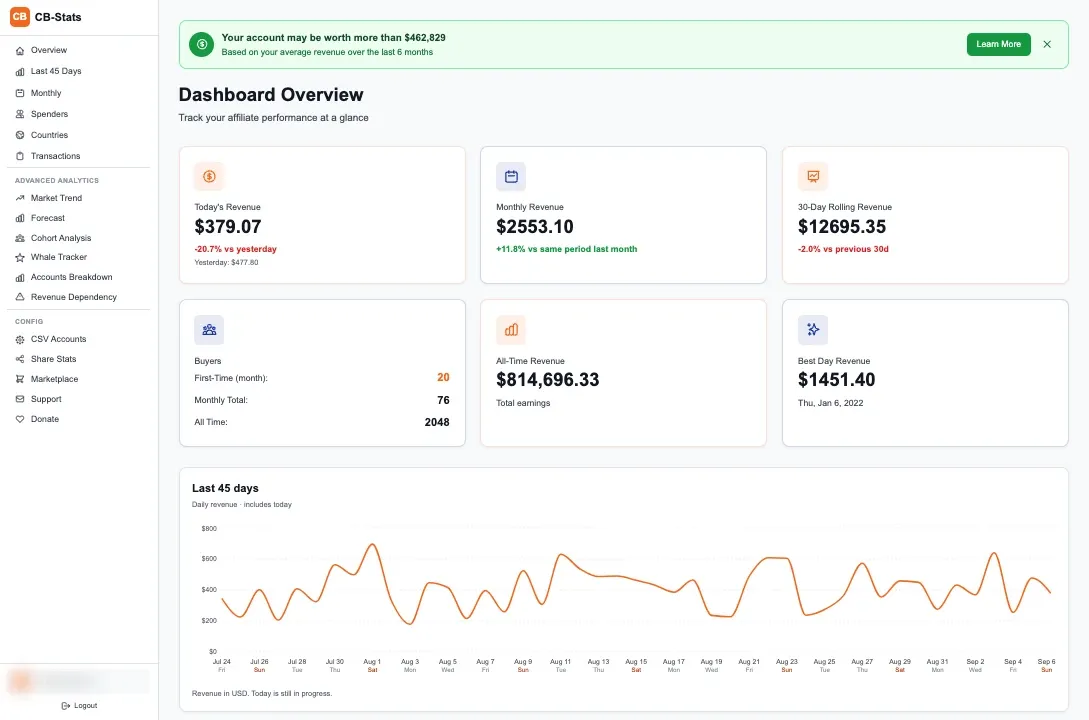
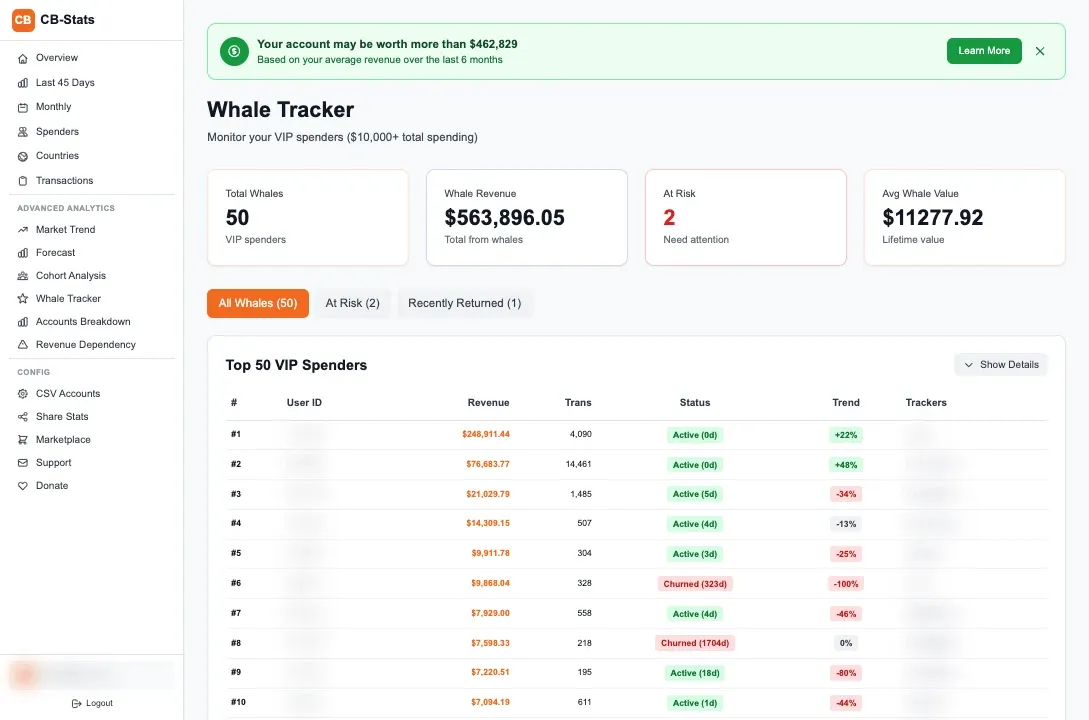
The cam site affiliate revenue guide covers the revenue models in detail. For tracking how your whales (high-value spenders) behave over time, the whale tracking features in CB-Stats are built exactly for this use case.

Frequently Asked Questions

How long does it take to make $5,000/month as a cam affiliate?

Most cam affiliates who reach $5,000/month do so within 18-24 months of consistent work. This assumes publishing 8-15 articles per month, promoting 2-3 platforms, and building at least 1-2 niche sites. The timeline accelerates significantly after the $2,000/month mark because lifetime revshare compounds from earlier referrals.

Should I hire writers for my adult affiliate site?

Hire your first writer when you consistently earn $1,000-1,500/month and have a proven content formula you can hand off. Expect to pay $0.05-0.08/word for adult content. Budget $800-1,200/month for 1 part-time writer producing 8-10 articles per month. Test 5-8 writers before expecting to find 1-2 reliable ones who understand affiliate conversion.

Is paid traffic worth it for cam affiliates?

Paid traffic is worth it only after you know your revenue per click from organic data. If your organic RPC is $0.38 and you can buy clicks for $0.15 on ExoClick, the math works. Start with a test budget of 10% of your monthly organic revenue. Most affiliates should not touch paid traffic until they earn $2,000+/month from organic sources.

How many niche sites should a cam affiliate run?

Most successful cam affiliates run 2-3 niche sites. Start a second site only when your first hits its keyword ceiling (around $2,000-3,000/month organic revenue). Running more than 3 sites requires a team of writers and becomes a management job rather than an affiliate marketing job. Each additional site has diminishing returns unless it targets a genuinely different audience.

What is the most important metric for scaling a cam affiliate business?

Revenue per 1,000 visitors (RPM) is the most important scaling metric. If your RPM is above $80, scaling traffic through more content or paid ads directly increases revenue. If RPM is below $50, focus on conversion optimization before scaling traffic. Most cam affiliate sites with good content and proper tracker usage achieve RPM between $70-$120.
Theory18 community

Join the conversation

Loading comments…